
Projects, Trails, Music and More
Links
View allListening
All weeksLatest stuff

Screenshot-a-Day: An Archive, Not an Alarm

A theme update breaks a hero image on Safari. A hosting provider changes a default. A CMS plugin starts injecting something. Nobody notices for six weeks, and when someone finally does, the only honest answer to “when did this start?” is a shrug.
I have given that shrug more than once. This week I shipped Screenshot-a-Day v0.1.0 so I would stop having to.
The idea is not new around here. It has been sitting on this site as a sketch since May 2024, back when I assumed the answer was a $10/year SaaS running Puppeteer on a Lambda. What actually shipped went the other direction on almost every one of those assumptions, and the reasons are the interesting part.
A Theme Meets a Stranger
I clicked the “Latest release” badge in Ryder’s README and landed on v0.0.1-alpha, dated January 2024.
That would have been unremarkable if it were the latest release. It wasn’t. Ryder had shipped v0.1.0 through v0.2.4, but the release workflow marked every automated release as a prerelease. GitHub excludes prereleases from that badge, so two years of releases were present, downloadable, and effectively invisible from the project’s front door.






Philadelphia to Los Angeles in Nine GPX Files
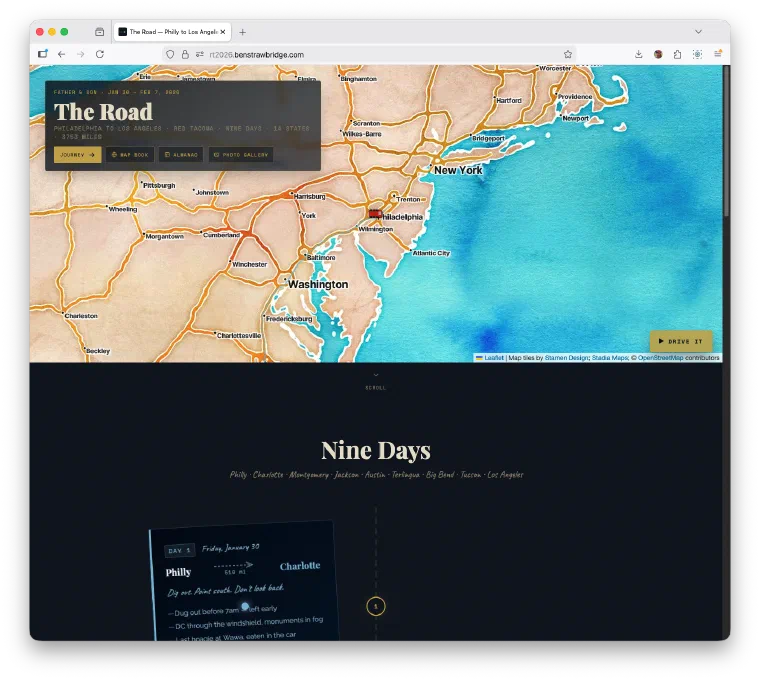
success Explore the Journey: rt2026.benstrawbridge.com In late January and early February 2026, my dad and I drove my 2008 Toyota Tacoma from Philadelphia to Los Angeles. The trip took 9 days. The odometer read 3,753 miles at the end; the day-by-day mapped dataset sums to 3,572 miles. I started this as a journal project, but as soon as I imported the GPX tracks it became a data project: route structure, speed regimes, and elevation signatures that are hard to capture in prose alone.
Beads and Gas Town: The Evolution of Coding Agent Memory
The landscape of AI coding assistants is evolving rapidly, and two recent developments from Steve Yegge are particularly interesting: Beads and Gas Town. These innovations address one of the fundamental challenges facing coding agents today: maintaining context and memory across sessions.
Deploying Hugo Websites to AWS CloudFront and S3 for Faster Content Delivery
A new way to deploy my hugo websites A simple and cost-effective approach to deploying Hugo projects to AWS CloudFront.
I have and still do use services like AWS Amplify and Netlify to automate my CI/CD pipeline for many of my projects, triggered by a GitHub check-in and running in GitHub Actions. However, for a recent photography project that involved deploying a large number of files, storing everything in GitHub wasn’t feasible. I needed a solution that was simple, affordable, and delivered high performance. That’s when I decided to use AWS CloudFront with an S3 bucket, integrated with an SSL certificate generated through CloudFront.
Why AWS CloudFront?

Content Adaptor Projects
Content Adaptors come to Hugo! A long anticipated release has come to the hugo static site generator that will be a real game changer. This is part of release v0.126.0. The new feature, called Content Adaptors allows you to generate static pages in your public directory at build time from a remote resource, such as an api.


Ingredients Section
Check out the new Ingredients Taxonomy pages
Using Taxonomy effectively As part of the recipe template configuration being developed for The Ryder Theme for Hugo websites, a new taxonomy is created for ingredients. Ingredients are not the same as recipeIngredients; they are defined as an array in the front matter. I didn’t want a taxonomy page generated for every single recipe ingredient, so I created a separate variable. The recipeIngredients are used to display the ingredients on the page and for the recipe schema, ensuring the pages are properly displayed as recipe rich results in Google and other search engines.